
Introduction
Recent geopolitical tensions involving Iran have drawn global attention due to their potential impact on international trade and supply chains. One of the most critical areas affected is the Strait of Hormuz, a strategic maritime passage connecting the Persian Gulf to the global ocean.
A significant portion of global oil shipments and international cargo passes through this corridor daily. Any disruption or military tension can quickly affect logistics, transportation costs, and industrial production.
For industries relying on global trade, including the tissue paper and pulp sector, these effects may be indirect but meaningful. Rising freight rates, volatile energy prices, and supply chain disruptions can influence raw material costs and the price of finished products.
This article explores how the current geopolitical situation could impact global shipping, tissue paper raw material costs, and sourcing tissue products from China, with the latest market data incorporated.
1. Impact on Global Ocean Shipping
Increased Risk in the Strait of Hormuz
The Strait of Hormuz is one of the world’s most strategically important maritime routes. It connects major oil-producing countries in the Middle East with international markets across Asia, Europe, and North America.
During periods of military tension, shipping companies take precautionary measures, leading to slower traffic, rerouted shipping lanes, and additional safety inspections. Even if the strait remains open, perceived risks can affect global shipping schedules and container availability.
Rising Freight Costs and War-Risk Insurance
Geopolitical conflict often results in higher war-risk insurance premiums. Shipping lines must purchase extra coverage to protect cargo and vessels traveling through potentially dangerous areas.
These insurance costs are typically passed along as freight surcharges, which can increase transportation costs for importers and exporters. Additionally, shipping lines may adjust global pricing structures to offset operational risks, further raising logistics costs.
Energy Price Volatility
Energy prices are closely tied to Middle East stability. Oil price fluctuations directly affect marine bunker fuel, a major component of shipping expenses. Higher fuel costs can translate into rising freight rates, affecting industries worldwide, even those not directly trading with the region.
2. Impact on Raw Material Costs for Tissue Paper
Energy-Intensive Manufacturing
Tissue paper production is highly energy-intensive, including pulping, drying, converting, and packaging. Rising energy prices impact:
-
Electricity and steam generation
-
Transportation of raw materials
-
Chemical processing and additives
Since energy accounts for a significant portion of production costs, fluctuations directly affect tissue manufacturing.
Recent Price Trends in Pulp and Paper Markets
Recent industry data show that raw material costs in the paper supply chain continue to face upward pressure:
| Material | Price (CNY/ton) | Trend | Notes |
|---|---|---|---|
| Pulp Futures (Mar 2026) | 5,300 | ↑ +2.1% | Main contract |
| Softwood Pulp Benchmark | 5,241 | ↑ +1.8% | Major domestic suppliers |
| Hardwood Pulp Benchmark | 4,565 | ↑ +2.3% | Export benchmark |
| Tissue Jumbo Roll Avg Price | 5,850 | ↑ Stable | Domestic market spot |
| Corrugated Paper | 2,764 | ↑ +0.6% | Minor upward pressure |
(Sources: fxbaogao.com, goodsfu.10jqka.com.cn, stock.hexun.com, sohu.com)
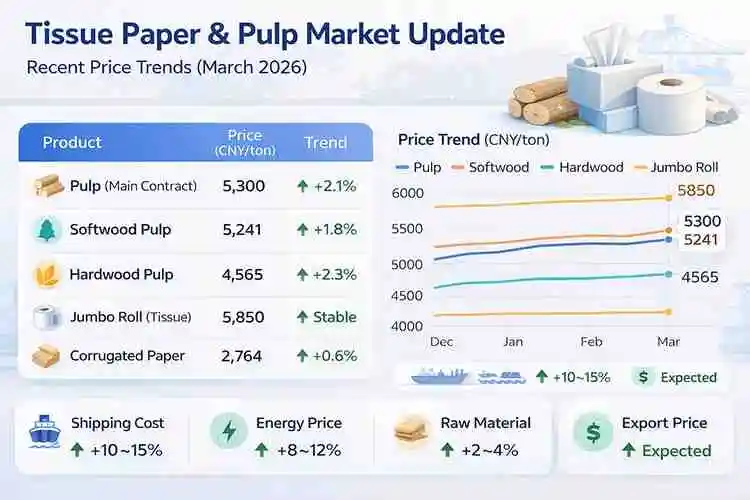
These trends show that pulp accounts for 60–70% of total tissue production costs, meaning even small price increases significantly affect final product costs.
Supply Chain Pressure
When energy, logistics, and raw material prices rise simultaneously, tissue manufacturers face cost pressures. Companies respond by:
-
Optimizing production efficiency
-
Adjusting product pricing
-
Exploring alternative raw material sources
These adjustments may eventually influence global tissue product prices.
3. Impact on Sourcing Tissue Products from China
China is a leading producer and exporter of tissue paper. Many international buyers rely on Chinese manufacturers for bulk or private-label products due to production capacity and competitive pricing.
Higher Ocean Freight Costs
Freight costs are a major component of total landed cost. Even if shipments do not pass through the Strait of Hormuz, global shipping market interconnections mean that cost increases elsewhere can influence pricing for China exports.
Manufacturing Cost Pressures
Chinese manufacturers also face rising costs due to energy price fluctuations and pulp market volatility. Benchmark pulp prices—Softwood CNY 5,241/ton, Hardwood CNY 4,565/ton—signal potential cost pressures for exporters.
Supply Chain Uncertainty
Geopolitical instability may cause fluctuating freight rates and extended shipping times. Buyers should plan procurement proactively and maintain flexible sourcing strategies.
4. How Buyers Can Manage Risk
-
Maintain proactive inventory: Ensure adequate stock to buffer delays
-
Monitor freight trends: Book shipping space in advance
-
Partner with reliable suppliers: Ensure production stability
-
Flexible procurement strategies: Adjust order sizes or schedules
These strategies help mitigate risks from geopolitical and market uncertainties.
Conclusion
While the Iran conflict may seem geographically distant, its economic impact spreads across global supply chains. Tissue paper manufacturers and importers are likely to experience higher freight rates, rising energy costs, and pulp price volatility, affecting the cost of sourcing products from China.
Proactive monitoring, flexible procurement, and strong supplier relationships remain essential for navigating these challenges.
About Us
We are a professional tissue paper manufacturer and exporter in China, committed to providing international customers with stable supply, consistent quality, and competitive pricing.
Our product range includes:
-
Toilet paper
-
Facial tissue
-
Napkins
-
Kitchen paper towels
-
Private-label tissue products
With robust production capacity and export experience, we help global partners maintain reliable supply chains even in volatile markets.
Contact us today to discuss your sourcing needs and explore our product offerings.